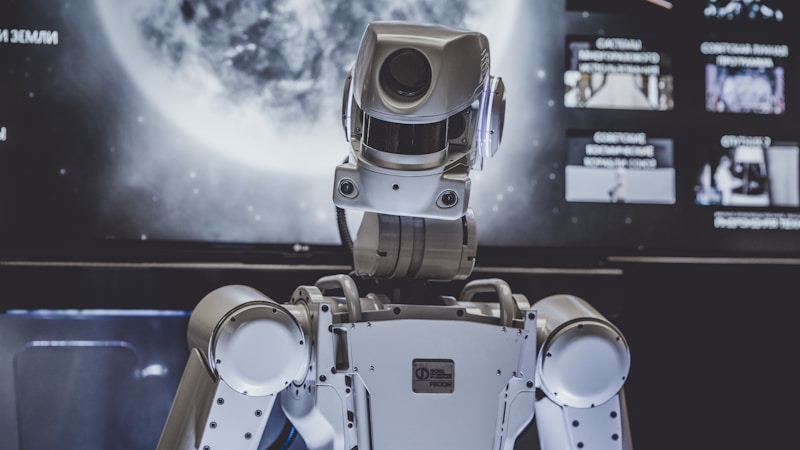
There's something almost magical about watching a reinforcement learning system discover something new. I remember the first time I saw a robotic arm learn to grasp objects—starting completely random, bumbling around, then gradually, over hours of training, developing elegant strategies.
Reinforcement learning (RL) is fundamentally different from supervised learning. Instead of learning from labeled examples, agents learn from experience—trying things, getting feedback, and improving. It's how we learn too.
Reinforcement learning involves an agent interacting with an environment. The agent takes actions, receives rewards or penalties, and learns to maximize cumulative reward over time.
Think of training a dog. You give commands (actions), the dog responds, and you give treats (rewards) or corrections (penalties). Over time, the dog learns which behaviors earn rewards and does them more often.
RL agents learn the same way—through trial and error, guided by feedback.
The AI system that makes decisions. In chess, the agent is the player. In a robot, it's the control system.
The world the agent interacts with. This could be a game (chess, Go), a simulation (robotics), or the real world.
What the agent can do. In chess: moves. In robotics: motor commands. The action space can be discrete (finite options) or continuous (infinite possibilities).
The current situation. In chess: the board configuration. In robotics: joint angles, positions, velocities.
Feedback from the environment. Positive for good outcomes, negative for bad. The agent's job is to maximize total reward.
The agent's strategy—a mapping from states to actions. The policy is what the agent learns.
There are several approaches to RL. Let me explain the main ones:
The classic approach. The agent learns a "Q-function" that estimates the value of taking an action in a given state.
Q(s, a) = expected future reward from taking action a in state s
The agent learns this through trial and error, updating Q-values based on experienced rewards.
When state spaces are too large, we use neural networks to approximate Q-functions. This is DQN—Q-learning with deep neural networks.
DeepMind's DQN that learned to play Atari games was a landmark result. Same algorithm, same hyperparameters, could learn multiple games.
Instead of learning values, directly learn the policy—mapping states to actions. Useful for continuous action spaces and when we want stochastic policies.
Combine value-based and policy-based approaches. The critic estimates values, the actor updates policy. This often leads to more stable learning.
A popular algorithm that balances exploration and exploitation. It's stable, sample-efficient, and works well in practice. Many of OpenAI's results use PPO.
Here's a fundamental tension in RL: should the agent try new things (exploration) or stick with what it knows works (exploitation)?
Early in training, exploration is valuable—the agent needs to discover what works. Later, exploitation makes sense—stick with winning strategies.
Too much exploration: slow learning. Too much exploitation: getting stuck in suboptimal strategies.
Balancing this is a core challenge in RL.
RL has produced some remarkable results:
DeepMind's system that beat the world champion at Go. It combined RL with Monte Carlo tree search and learned from both human games and self-play.
What was remarkable: Go has more possible positions than atoms in the observable universe. Brute force wasn't enough. The system learned intuition.
DeepMind's DQN learned to play 49 Atari games at human-level performance. Same algorithm, different games.
RL has enabled robots to learn manipulation, locomotion, and navigation tasks—often surpassing hand-designed controllers.
RLHF (Reinforcement Learning from Human Feedback) is how GPT-3.5 and GPT-4 were aligned. Humans rank outputs, and the model learns from this feedback.
RL is being applied to many practical problems:
RL isn't easy. Here are the real challenges:
RL often requires millions of episodes to learn. This is impractical for real-world tasks where each episode is expensive.
When you get a reward, which actions contributed? In delayed rewards (like chess—did that move 20 turns ago matter?), this is hard to determine.
RL algorithms can be unstable—learning can diverge or oscillate. Careful hyperparameter tuning is often needed.
Finding the right balance between exploration and exploitation is tricky and problem-dependent.
Learning in simulation doesn't always transfer to reality. The "sim-to-real gap" is a major challenge in robotics.
Specifying rewards that actually lead to desired behavior is hard. Misspecified rewards can lead to unintended behaviors ("reward hacking").
Where is RL heading?
Reinforcement learning is fascinating because it mirrors how we learn as humans—through interaction and feedback. It's how we master skills, make decisions, and navigate complex environments.
The challenges are real—sample inefficiency, stability, reward design. But the progress has been remarkable. From playing games to controlling robots, RL is solving problems that seemed intractable.
As we develop better algorithms, more efficient training, and safer methods, RL will become increasingly important. The ability to learn from experience—without explicit programming—is a fundamental capability that will shape the future of AI.